

The big sheep

Mutton is fashionable again after a gap of almost a century. Its supporters say: "Mutton is to lamb what beef is to veal."
The comparison is tempting. Up to a point, it's true. It's also problematic - in a catering context, at least. Beef butchery, because of the animal's size, is very different from that of veal. The respective ages of a mature bullock and a calf reared for the table are such that the recipes for each have evolved to reflect size, succulence and tenderness.
However, between lamb, hogget (an intermediate stage of the animal's age, though not necessarily its growth) and mutton, size isn't really an issue. Most lamb, spring lamb apart, is almost fully grown when slaughtered. Before trimming, one style of "mutton" may be more fatty, another scrawny, but neither will be significantly meatier.
Mutton has a stronger flavour. Whether this is desirable or not depends on the way it is produced. Its texture is also firmer (though not much, after hanging), but a chef can roast, grill or pan-fry a mutton chop as well as any lamb one.
If it's to become a serious alternative to lamb, though, mutton has to deliver consistent quality at a competitive price. Chefs can buy rare-breed lamb, either graded British or New Zealand or imported AOC. Without reaching for a butcher's knife, they can buy any pre-prepared cut, from a Barnsley chop to Frenched rack.
With choice and reliability already available from lamb, not to mention customer acceptance, chefs need good reasons to switch to mutton. One is that mutton is a distinctive meat. Another is that it's adapted to the cookery of the colder months - what restaurant reviewers call "robust cuisine". It has the same appeal as chargrilled steak or roast rib of beef.
Also, the secondary cuts punch above their weight. If the quality of the meat is high enough to start with, neck of mutton, whether cooked en daube or as an oven dinner or an Irish stew, is delicious.
Strictly speaking, mutton isn't seasonal; placed in opposition to lamb, it effectively becomes so. Chefs who buy older lamb through the winter should give carefully sourced mutton a chance.
Chris Staines
Llangoed Hall, Lucknam Park, Chez Nico, the Oak Room - the steps on Chris Staines's route to becoming head chef at Foliage at London's Mandarin Oriental Hyde Park hotel define his style of cooking. He has a sound grounding in country house hotel cooking, with its ready access to local produce.
On to his respect for the quality of his raw materials he has grafted the technical accuracy learnt in the 1990s when working with London's three-Michelin-starred masters, Nico Ladenis and Marco Pierre White. "I don't like to mess around with food," Staines admits. "Cooking at its best should be seasonal. We try to use the perfect produce for the job."
Roast shoulder of mutton
Lamb, hogget and mutton Technically, the meat trade draws loose distinctions between lamb, hogget and mutton that don't make life any easier for caterers.
Lamb describes sheep killed in the year in which they were born, providing that birth was before 31 September. Those born during the last three months of the year continue to be classified as lambs through the following year. Given this technical definition, "lamb" may be anything from two to 15 months old.
Hogget describes a sheep killed in the first six months after the year in which it was born, unless its birth took place after 31 September, in which case it can be classed as hogget during the first six months of the second year after birth - in other words, anything from four months to 21 months old.
Mutton doesn't have a legal definition to differentiate it from hogget, but by convention the meat is two years old or more. It has a stronger, almost gamey taste, depending on age and source, and its texture is firmer. When raw, the meat colour is
darker. It should not come from rams, or from ewes that have recently given birth or ceased to breed.
"Culled ewes" are adult sheep, used for breeding - they haven't been reared for their meat. They may enter the food chain as mutton, but their eating quality will fluctuate.
Renaissance Mutton Quality Assurance Scheme Chefs such as Chris Staines who buy farm-gate meat have a direct line to sourcing and can apply their own specifications to the meat they choose to buy.
However, the Renaissance Mutton Quality Assurance Scheme, supported by Eblex (the English Beef and Lamb Executive) and the Academy of Culinary Arts, exists to guarantee a measure of quality in a raw material that isn't regulated.
The following requirements must be observed:
Producers must be Farm Assured.
Eligible sheep must be over two years of age - to be confirmed either by documentation or by dentition.
Eligible sheep must be either females or castrates. Entire males are not acceptable.
The number of sheep in the flock must be submitted with sheep for slaughter.
All eligible sheep must be sent directly to the abattoir from the producer's holding.
There are no breed specifications.
Diet must be forage-based.
In the abbatoir:
Carcass classifications of O, R, U and E for conformation (muscle yield), fat classes 2, 3L and 3H are required - U and E grades are the most desirable.
The carcass must be hung complete for at least two weeks.
Contact Matt Exley on 0117 924 4300 or matt@kabassa.co.uk for a list of producers.
Jointing At Foliage, Chris Staines uses the following cuts, working with the same prime cuts that are traditional for lamb.
Legs: Cut out the aitch bone and seam out the rump (two portions). The leg can be roasted or cut into steaks and braised like osso bucco (about eight portions).
Loins: Either roasted as a saddle, or used as for conventional lamb recipes (two portions per loin).
Best end: Seven-bone joint that can be treated as for lamb - two portions.
Neck: Slow-cooked like oxtail or as a daube (four portions).
Breast: Remove the skirt, cut out the rib ends, trim, score the meat with a criss-cross pattern, roll like a Swiss roll and tie (served in combination with other cuts, yields about 1kg).
Roast shoulder of mutton Approximate raw weight: 2.5kg to 3kg
Portioning: This depends on the style of
service. At Foliage, one joint may yield four portions, because the ends have to be trimmed
for presentation reasons. In a pub, brasserie
or bistro, a shoulder should give five or six servings.
Tunnel-boning the shoulder When boning a shoulder, think of the three main bones as forming a letter Z.
Separate the shoulder from the forequarter, following the natural line of the limb (1). The shoulder blade joins the carcass between the neck and the last of the fore-ribs. A ridge runs through the centre of the shoulder blade. It's simpler, when exposing the shoulder blade, to work on either side of it (2).Lay the shoulder skin-side down. Pare the meat away from the blade bone, keeping the knife flush against it (3).
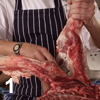
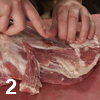
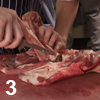
Keeping the knife against the bone, cut along the edges and underneath it and expose the axe-shaped bone, without cutting through the skin.
The blade joins a thigh bone (humerus). Carefully cut around the joint and then loosen the meat from around this bone (4).
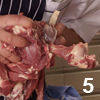
When the bone is fully exposed, the meat can be pulled back down to the next joint (effectively, the knee) without using a knife - like pulling down a sock (5).
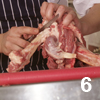
Cut around the ball-and-socket joint and remove the blade and thigh-bones (6).
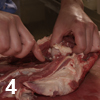
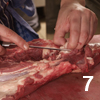
You can leave foreshank bone in place for the meanwhile, but there's a small bone about 7cm long that needs to be extracted (7). Try not to cut through the skin when taking it out, though this is easily done because it's so close to the surface.
Stuffing and tying
Ingredients 6 anchovies, salted
Zest of a lemon, grated
1tbs garlic purée
2tbs parsley, coarsely chopped
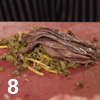
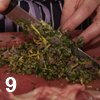
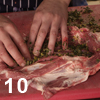
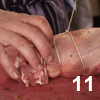
Method Combine the stuffing ingredients (8 and 9). They are more of a seasoning. Rub them thoroughly into the meat. Roll the joint to form a cylinder (10), with the shank attached. Tie the rolled joint (11), but not too tightly because the meat swells when cooked, finishing at the shank. Cut off the shank bone.
Sous vide pre-cooking
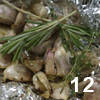
Ingredients (12)
Whole garlic cloves, to taste
10g (approx) sea salt
1 large sprig rosemary, thyme or similar herbs
2tbs oil (sunflower or olive to taste)
Method
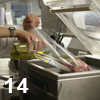
Put the mutton into a sous vide bag with garlic, salt, herbs and oil (14). Vacuum-seal. Immerse completely in a pan of water at 80°C for 20 minutes or steam at the same temperature.
Roasting
Ingredients
30ml oil
60g butter
Method
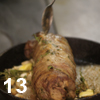
Preheat the oven to 180°C (or 150°C-160°C for a convection oven). Unwrap the joint. Heat the oil in a pan and add the butter. Sear the meat on all sides, basting it regularly (13) until the surface has caramelised (15).
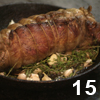
Put it in a roasting tin with the herbs and juices. Roast 20 minutes. Rest while assembling the garnishes.
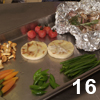
Garnishes for Foliage's roast shoulder of mutton Ingredients (16)
Blanched and trimmed sweetbreads, sautéd in butter and caramelised with reduced balsamic vinegar
10cm disc of dauphinoise potato
Baby turnips
Baby carrots
Sugar peas
Haricots verts
Assembly
At Foliage, the joint is presented to the customer first (see main picture, above) then returned to the kitchen for plating. Cut the string from the meat and carve a thick slice from it. The meat will be slightly pink. Arrange it on a disc of dauphinoise, with the vegetables and sweetbread around it.
Mutton jus Mutton bones and trimmings make good stock - because the bones are older, this won't be as gelatinous as lamb, veal or even chicken stock.
Chop the bones. Coat with oil. Put them in a roasting pan. Roast with half their weight of mirepoix, garlic, tomatoes or tomato skins, rosemary and a bouquet garni. When thoroughly coloured, transfer to a large casserole.
Strain off the fat in the roasting pan. Deglaze it with water or wine. Add this to the casserole. Top up with water - about two parts liquid to one of bones and vegetables. Boil, skim and simmer for four to six hours.
Strain several times. Reduce with an equal amount of brown chicken stock and season.
Historical note In her first edition of her Book of Household Management (published in 1861), Mrs Beeton wrote that mutton was "undoubtedly the meat most generally used in families". It came from animals between three and five years old. Epicures claimed to prefer the meat from wethers (castrated males) - equivalent to beef steers.
Its decline from most popular to virtually forgotten meat in only a century is partly down to economics, partly to changing public taste, partly to the wide variations in quality that must have existed. We switched because our farmers and those in New Zealand could provide more consistent lamb at a lower cost. It was a prime meat reared directly for the table, whereas the meat of mature sheep was too often a by-product of the wool industry.


