

Globe artichokes

How long does it take to eat an artichoke? If you pull the petals off one by one, dip them in vinaigrette and suck the ends, it's a very long time - not the sort of dining experience most restaurant customers now want, though it did enjoy a kind of fashion 30 years ago. These days, it's the artichoke bottoms that the dining public find more desirable, but from the chef's point of view, trimming them is something of a chore.
At London's Zafferano, where Andy Needham is head chef, his kitchen prepares almost 500 small purple artichokes a week. The responsibility for this lies with Michaele Nargi, his sous chef. Like shucking oysters, speed comes with practice, but it helps when the artichokes are super fresh and firm.
Italians, more than the French, are passionate about purple and green artichokes. There are hundreds of recipes, from the stuffed round carciofi ripinei of Rome to the Venetian artichoke lasagna, via the Tuscan artichoke risotto and the simple Pugliese way of dishing them up with grated cheese, breadcrumbs, capers, olives, lemon juice and oil.
In taste, texture, colour and overall effect artichokes have style, especially the smaller, elongated purple ones. They are strong enough to be the focal point of a dish, not, as many vegetables seem to be, a garnish or an accompaniment.
Artichokes are floral buds. In other words, left on the stem they open out, and purple, thistle-like flowers will form. The overlapping petals are technically known as bracts, though they are often called "leaves" in recipe books. The fleshy bottom is the "choke" proper, not the furry down (the sepals) that covers it.
Andy Needham "Pronto!" (Ready!) Andy Needham in his kitchen at Zafferano speaks fluent Italian with his brigade. It's not forced, but comes naturally to a Yorkshire-born chef who has worked in Piedmont, Lombardy and Sardinia, not to mention France and Catalonia.
If there's a persistent theme running through his cuisine, it's the importance of sourcing fresh produce. He develops personal contacts with suppliers in markets around Europe and buys the best available to ensure that the flavour of the raw materials is always the focal point of his dishes.
He took over the Belgravia restaurant in 1999 after his friend and previous boss Giorgio Locatelli moved on, and has retained the restaurant's Michelin star for his own cooking since that time. He has enlarged the dining rooms - serving up to 1,700 covers a week - and revamped the kitchen. In 2004 Zafferano was voted best Italian restaurant in the UK.
SELECTION
Types and sizes There are theoretical and practical distinctions between different kinds of globe artichokes. At the simplest level they can be separated into those with spines on the petals (not often bought by our chefs, though popular in Europe and a speciality of Sardinia) and those without. Of the latter, the big, round Breton ones, especially the Prince de Bretagne variety, are what the French choose for their fonds d'artichauts (artichoke bottoms), while the tapering, often purple-tinted, ones are what Mediterranean cooks, with Italians to the forefront, prefer.
Tiny artichokes picked at the end of the season, which appear to have grown as an afterthought on the plant's side shoots, are occasionally found and may be tender enough to eat raw.
Freshness The feel of a fresh artichoke is firm and compact, quite heavy in the hand in relation to its size. This changes to a looseness as the plant dehydrates. At Zafferano, the chef usually cuts a sample fresh artichoke in half on taking delivery, because the bottoms may have otherwise invisible pest damage and the appearance can be misleading.
Artichokes that have been left too long on the plant before picking may be stringy, with fibres running from the stem into the bottoms.
Sources and seasonality Artichokes are available all year round from different European countries. In spring, the smallest Italian varieties, mainly from Puglia, Tuscany and Campania, are at their best. In summer, the French export quantities of the large Breton artichokes to the UK; and in winter the Spanish varieties are predominant.
Carciofo violetto di Sant'Erasmo The Italian Slow Food movement, which singles out special produce to preserve through its Presidia scheme, recognises this unique artichoke grown on the island of Sant'Erasmo in the Venice Lagoon. It has a season lasting from April to June and is a particularly succulent spiny purple variety.
BASIC PREPARATION
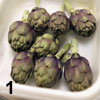
At Zafferano, Andy Needham buys about 10 boxes of artichokes a week, so he is preparing larger batches than will appear in the sequence of pictures above.
Cost price £22 per box of 48 small artichokes.
Selling price An artichoke starter with burrata (see panel, page 26) and peas, which includes three artichokes per portion, is £10.
Tip If you are preparing large batches, wear surgical gloves, because the artichokes will stain your hands.
Advance preparation
Fill a basin - large enough to hold the trimmed artichokes - with cold water containing either halved lemons or lemon slices to prevent the cut surfaces blackening.
Snip off the cut end of the stem, leaving a generous 5cm stalk attached to the artichoke. Pull off any leaves attached to the stems (1).
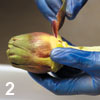
Pull off the outer three layers of petals. These will be too leathery to eat. The artichoke looks like a closed tulip (2).
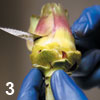
Cut off the tops of the flowers about 2cm above the base (3).
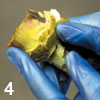
Trim the ragged edges around the base (where the outer petals were pulled off) (4). The neatest way of doing this is to use a thin-bladed stainless-steel knife and pare at right angles to the base.
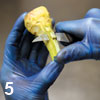
On fresh, young artichokes the stems are tender and edible. They shouldn't be discarded. Peel the outer skin from them, working from
top to bottom (5).
Small artichokes are ready to cook at this stage, but at Zafferano they receive two further stages of trimming (see below).
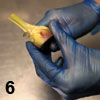
Cut the artichokes in half (6). Start at the base of the stem and split it until you reach the artichoke heart. Cut it in two (7).

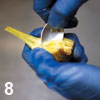
Take a teaspoon and scoop out any of the furry residue - sometimes called, in error, the "choke" - in the base (8).

Drop the halved artichokes into the water with lemon (9).
Fonds d'artichauts
Large, green Breton artichoke bottoms - fonds d'artichauts - are prepared in much the same way, except that the stems are cut off at the base.
Pull away all the outer green petals.
Trim the edges round the base and scoop out the centre with a knife or spoon.
Rub cut surfaces with a lemon before dropping into water.
BLANCHING AND MARINATING
The quantity of liquid used for this depends on the number of artichokes being prepared. The important thing is to get the proportions of liquids right. For about 24 small artichokes (eight portions) allow a minimum of two litres of liquid.
As a rough guide, a 10-litre pan with five litres of liquid in it will be adequate to blanch 1kg of artichokes.
Use two parts water, one part dry white wine, one part wine vinegar.
Put the liquids in a large pan with plenty of room to contain the artichokes. Bring to the boil. Drop the artichokes in and cook for about five minutes. They are ready when a knife can penetrate the bottoms with no resistance (10).
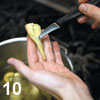
Compare the sensation to testing whether a new potato is cooked. Drain and dry.
The next stage requires extreme care.
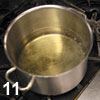
Heat 2.5 litres of olive oil in a large pan - at least 10 litres capacity (11). You'll also need either a tight-fitting lid or a pan that can act
as a lid.
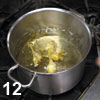
When the oil just about reaches boiling point, add fresh herbs to taste - about 60g rosemary, thyme and bay leaves, plus a halved head of garlic. They should sizzle gently on contact with the oil, creating small bubbles on the surface (12). Leave on a very low heat to infuse until the cut surfaces on the garlic turn a light golden brown .
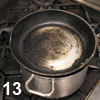
Have the lid or pan ready (13). Turn off the heat.
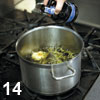
Pour 100ml vinegar (condimento morbido - see panel, page 26) into the pan oil, covering it as quickly as possible with the lid (14). There will be an alarming spattering and spluttering, but keep the lid in place until the noise dies down and the temperature dips to about 70°C. It's safe to remove the lid at this stage.

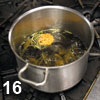
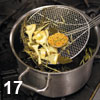
\* Add the artichokes and 25g salt (15). Leave them to cool in the marinade (16). Transfer them, bathed in the marinade, to a storage container and leave for a minimum of 24 hours before use (17). The flavour continues to improve over the next few days.
Note If the marinated artichokes are put in bottles and sterilised, they become a conserve which keeps indefinitely.
CARCIOFI MARINATI CON BURRATA E PISELLI
INGREDIENTS (Serves eight)
6 shallots
100ml red wine vinegar
3 green tomatoes
Salt
3tbs condimento morbido
2tbs basil oil
60g pea shoots
About 60ml Tuscan or similar peppery olive oil
300g burrata (see panel below)
120g fresh peas, cooked
About 48 pieces marinated artichokes, halved
Chives
METHOD Dice shallots and marinate them in wine vinegar for three hours or more. (This can be done as a standard part of mise en place.) Quarter and seed the tomatoes. Blend in a food processor. Transfer to a chinois and squeeze out any excess juice. Combine the purée with basil oil salt and a little condimento morbido. Form eight teaspoon-sized quenelles. Dress the pea shoots with a little Tuscan oil and condimento morbido.
For each portion, pile the pea shoots over a bed of peas. To one side, spoon the burrata and put a green tomato quenelle on top.
Pat the marinated artichokes dry and coat them lightly with oil and condimento morbido. Arrange six pieces between the burrata and the pea shoots. Sprinkle some shallots and chives on top.
Sommelier's suggested accompaniment Cayega (Tenuta Carretta) - a dry, pale yellow Piemontese wine made from Arneis grapes, which has a floral, fruity nose with a mineral aftertaste
Condimento morbido
This white, sweet and sour vinegar is obtained by mixing fresh vinegar with Trebbiano grape must and then ageing the blend in barriques. It belongs to the same family as balsamic vinegar, but is better adapted to dressings and marinades.
Burrata
A fresh cheese from Puglia, burrata is made by blending mozzarella with cream and enclosing the mixture in a "sack" made from pasta filata - the basis of mozzarella. (Imported by La Credenza, 020 7070 5070.)


