

Marco Pierre White prepares lobster with sauce vierge

Marco Pierre White's unique talent as a three-Michelin-starred chef was to recognise great dishes and take them up a notch, making them his own.
Sauce vierge is a modern classic that was popularised during the 1980s by Michel Guérard at Eugénie-les-Bains. In its original form it was a Mediterranean dressing that contained plenty of garlic. It was eaten either cold or hot after infusing the herbs in the oil.
White's take is more Italian than French. He has cut out the garlic, balanced the oil with lemon juice, added black olives for colour, and sprinkled the herbs over the dish to retain their freshness. His two-stage approach to cooking the lobster is equally clever. He part-cooks it in a court bouillon, rests it to settle the meat, then finishes by roasting it in the oven, basted with oil and butter.
This is a self-contained dish, with no garnish and no attempt at prettiness, that allows for no compromises. It has to be done from scratch, to order.
Marco Pierre White prepares lobster with sauce vierge
Basic court bouillon for lobster
Because the lobster in this recipe is only part-cooked by the liquid, the composition of the court bouillon is not critical. White prefers to omit salt, and he doesn't want the broth to taste of stewed vegetables.
Basic court boullion for lobster
Ingredients
(Makes about five litres)
4.5 litres water
Zest of a lemon
1kg (in total) of leeks, onion, shallots, carrots - coarsely chopped
20 black peppercorns, crushed
Fresh herb stalks to taste - such as fennel, tarragon, parsley
1 star anise
1.25 litres dry white wine (or 1 litre wine and 250ml white wine vinegar)
Method Put the ingredients in a pan except for the wine. Boil, and simmer 20-30 minutes only. Add the wine, return to the boil, take off the heat, cool and strain.
Oil and butter "pommade"
Ingredients (Makes about 500g)
250g unsalted butter
250g extra virgin olive oil
Method Soften and then cream butter in a mixing bowl. Incorporate an equal amount of extra virgin olive oil, a few drops at a time, to form a soft emulsion. Fill a piping bag (plain tube). To store, avoid temperature extremes - they'll either split the pommade or make it harder to pipe.
Lobster with sauce vierge Essentially, this is a simple recipe. What makes it challenging is timing. Its success hinges on à la minute cooking rather than complex advance preparation. For example, cooking and portioning the lobster ahead of service would not make it a bad dish, but it would not taste as good as when it's done to order.
Ingredients (Serves one main course or two fish courses)
5 litres court bouillon
1 x 600g lobster
11/2 ripe plum tomatoes
Handful black olives
100-150g oil and butter pommade
1tsp coriander seeds
100ml extra virgin olive oil (good-quality)
1 lemon
Fleur de sel or Maldon salt
Fresh basil
Fresh tarragon
Fresh coriander leaves
Method
Heat the court bouillon to 85°C in a pan with a diameter just large enough to take the lobster. Drop it into the simmering liquid. Set a timer for three minutes. If you are concerned about killing lobsters directly like this, leave them in the freezer for an hour before they are cooked - but poach for an extra 30 seconds.
Remove the parboiled lobster from the court bouillon - it won't have completely turned red. Transfer it to a bowl just large enough to contain it. Cover with clingfilm (1).
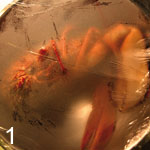
Leave in a hot part of the kitchen. Carry-over cooking allied to the hot environment will not finish the cooking process, but it will be enough to cook the claws. At the same time, the meat in the tail will relax, making for more tender, succulent eating.
While the lobster is resting, peel the tomatoes without blanching them. Seed, quarter and dice them. Reserve. Slice slivers of black olive off the stones.
In a small pan, toast the coriander seeds until fragrant. Cool the pan. Pour oil over the seeds. Add lemon juice - three parts oil to one of lemon. Set aside. Don't cook the oil or it will lose its fragrance. Reserve.
Preheat the oven to about 240°C. Pull off the whiskers from the lobster and reserve for garnish. Break off the two claws from the carapace.
To prepare the claws
Break each one into its three natural joints (2). Pull off the lower sections of the two pincers and extract the pointed flesh (3). One claw cuts, the other crushes, but the meat can be extracted from both in the same way.


