

Christmas log – a masterclass

Christophe Michalak's "treasure chest" is, perhaps, the acme of Christmas cakes. Michael Raffael discovers how the celebrated pâtissier creates it
No French Christmas would be complete without its yule log gâteau, the Bûche de Noël. But at the Plaza Athénée hotel in Paris, as if he were an expert carpenter, pâtissier Christophe Michalak has taken the wooden log and turned it into a "treasure chest".
Each year he makes a limited-edition seasonal cake that's ordered and sold out in advance. At €120 (£86) apiece, this might seem to be a frivolous luxury limited to the compass of the hotel's clientele. But, in fact, given the difficulty and the amount of labour involved in putting it together, its price seems a genuine bargain.
To make the cake, chef Michalak must blend skills that are both conceptual and managerial. He has to design, engineer and organise its manufacture this involves making Thermoform and PCB moulds, a mise en place of seven separate "masses", seven kinds of chocolate, a well-equipped professional pâtisserie, and no little manual dexterity.
Although the recipe as a whole wouldn't - and, arguably, shouldn't - be imitated, its component parts are both simple and practical, and point directly to lines along which modern pastry work is evolving.
Treasure chest
Christophe Michalak produces only 150 of these each year, and sells them for €120 (£86) apiece.
Ingredients (Serves 6-8)
Biscuit moëlleux (mass 1) - about half the recipe
Chocolat crèmeux (mass 2) - about 100g from the recipe
Pailletté Feuilletine base (mass 3) - about one-quarter of the recipe
Milk chocolate mousse (mass 4) - about 350g
Semi-cylindrical chocolate couverture casket lid
Crème chantilly gianduja (mass 5) - about 60g
16-20 roasted hazelnuts, dusted with gold powder
Streusel sand (mass 6) - about 120g
Plastic chocolate (mass 7) - about 20g (and bronze dusting powder)
Method
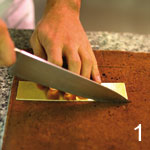
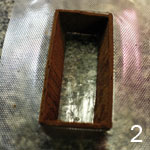
Cut out two rectangles of biscuit moëlleux (1) to line the sides of the Thermoform mould. Cut out two pieces to fit the ends of the mould. Fit them neatly into place (2).
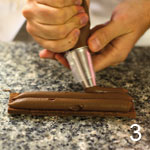
Cut a fifth rectangle to fit the dimensions of the mould. Using a piping bag with a plain tube (12mm or similar), pipe three strips of chocolat crèmeux on this rectangle (3) and place in the freezer for a minimum of one hour to set.
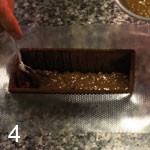
On the bottom of the Thermoform mould, spread a layer of Pailletté Feuilletine base, enough to coat it to about 10mm depth (4). Freeze for an hour to set.
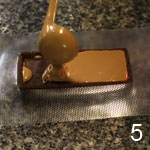
Take out of the freezer and spread a layer of milk chocolate mousse on the Pailletté Feuilletine (5). The form is just over half-filled at this stage.
Cut another rectangle of biscuit moëlleux and lay it on top of the mousse.
Take the almost-frozen sheet of biscuit moëlleux coated in chocolat crèmeux and fit it with the cream down against the cake. Turn out the cake base on to a presentation card.
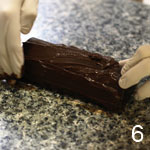
Coat the half-cylinder chocolate casket lid by hand (wear surgical gloves) with the mousse (6). Place in the freezer to set.
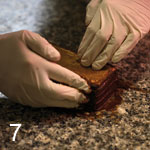
Coat the outside of the turned-out cake base with the mousse (7). Place in the freezer to set.
Varnish the outside of each piece with a pastry gun using a cocoa butter and couverture solution (300g melted cocoa butter mixed with 500g melted couverture).
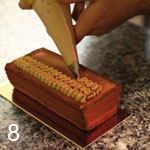
Fill a paper cornet with crème chantilly gianduja and, using a ripple design, pipe four rows down the surface of the cake (8).
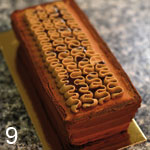
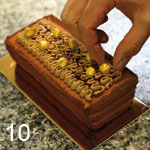
Fill a paper cornet with chocolat crèmeux and fill the gaps between the ripples (9).
Sprinkle roasted hazelnuts coated in gold powder on top (10).
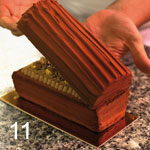
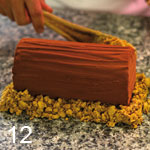
Fit the casket lid on top of the cake (11). Arrange streusel sand around the base, pressing it against the sides of the chest so it looks as though it's lying on a beach (12).
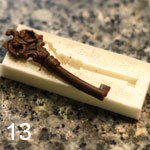
Take a piece of the plastic chocolate and press it into the keyhole mould. Turn out (13). Do the same with the key mould and two handle moulds. Dust with bronze powder.
Stick the keyhole to the side of the casket with a little melted couverture. Stick the key on top of the casket. Stick the handles to its sides (a little nitrogen spray will help).
Mass 1: Biscuit Moelleux Au Chocolat
A professional pâtissier will probably make several sheets of this chocolate cake at a time. If you prepare less than 800g batches you'll find it hard to keep it smooth and even.
Material
Prepared baking sheet (silicone, Silpat) about 31cm x 25cm.
Ingredients
220g Manjari couverture (64% cocoa solids)
115g butter
105g egg yolks
209g egg whites
115g caster sugar
37g plain flour, sifted
Method
Melt the couverture and butter together and mix in the yolks. Whisk the whites and sugar to form a soft meringue. Fold into the chocolate. Fold in the flour. Spread over the baking sheet in a very fine layer. Bake in a hot oven until just set (about three minutes). Cool and then trim edges. It should be about 5mm (a quarter-inch) thick.
Mass 2: Chocolat Cremeux
Ingredients
230ml whipping cream
230ml whole milk
80g egg yolks
60g caster sugar
150g Caraïbe (66%) couverture
150g Guanaja (70%) couverture
Method
Make a crème anglaise with cream, milk, yolks and sugar and dissolve the chocolate in it while it's still hot.
Mass 3: Paillette Feuilletine Base
Praline and wheat flakes: Pailletté Feuilletine is a Cacao Barry mixture of Breton lace pancake fragments.
Ingredients 200g hazelnut praline
200g hazelnut paste
200g Pailletté Feuilletine
200g Jivara (40%) couverture, melted
Method Combine the ingredients.
Mass 4: Milk Chocolate Mousse
Ingredients
160ml whipping cream
160ml whole milk
60g egg yolks
20g sugar
180g Tanariva couverture - milk chocolate and vanilla
470g Jivara couverture (40%) - malted milk chocolate
550ml whipping cream, whipped
Method
Make a crème anglaise with cream, milk, yolks and sugar and dissolve the chocolate in it while it's still hot. Cool until tepid and fold in whipped cream.
Mass 5: Creme Chantilly Gianduja
Ingredients
400ml whipping cream, lightly whipped
250g gianduja (chocolate and hazelnut)
Method
Mix to a fine piping consistency.
Mass 6: Streusel Sand
Ingredients
100g streusel or broken-up sugar pastry
40g Pailletté Feuilletine
25g roasted hazelnuts, chopped
20g Demerara sugar
1/2tsp gold powder
50g white chocolate, melted
Yellow colouring
Method
Combine all the ingredients together so they look like a coarse sandy beach.
Mass 7: Plastic Chocolate
Ingredients
500g couverture
100g sugar syrup
200g glucose
Method
Melt the couverture to 35°C. Pour the syrup over the glucose and combine. Blend with couverture to obtain a putty-like texture. Wrap and reserve.
The casket lid after coating with mousse
Advance preparation
To make the bûche, Christophe Michalak designs and makes:
- A Thermoform plastic mould with slightly tapering sides to fit the dimensions of the cake (about 20cm x 6cm x 6cm).
- Another matching half-cylinder mould for the lid of the cake.
- PCB moulds for the handles, lock and key of the casket, made from a wax impression.
Christophe Michalak ate junk food at home when he was growing up in a small town near Nantes on the French Atlantic coast. He toyed with becoming a chef, but found himself in trouble because he preferred doing pâtisserie. This, he soon decided, was his true vocation.
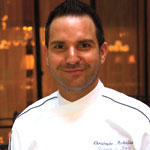
"In pâtisserie," he realised, "you can't say that anybody is ‘the best', but I knew very early on that I wanted to be a part of the élite."
It's an ambition he fulfilled when he became World Champion pâtissier in 2005.
On his way to the top, he spent a year at the Park Lane Hilton in London and another at the Brussels Hilton. He opened a pâtisserie school in Kobe, Japan, for the Niçois Gregory Collet, and a shop for Pierre Hermé in New York.
Still in his mid-20s, he was working as sous chef at the celebrated Paris Salon de Thé, Ladurée, when he learnt that Alain Ducasse was moving to the Plaza-Athénée and was looking for a chef-pâtissier. He was hired and, since 2000, has headed the hotel's brigade of 23 pastry chefs.
His role here, he believes, is more complex than in a retail pâtisserie. "Production is actually smaller, but it's far more diverse," he says. "Everything is geared to luxury. Also, we're fortunate in being located in Avenue Montaigne, which is identified with high fashion, so we're producing pâtisserie that has to be very seductive."
It's a common cliché that people eat with their eyes, but Michalak takes the argument a step further. "I've always associated what is beautiful with what is good," he says. "You can't make a very good pâtisserie that isn't attractive or sexy. Of course, you have to have an emotion when you taste, but it must look elegant."
Over the past two decades, he feels, the appearance of pastries has been evolving. Instead of highly decorated pieces, there's more restraint. The skill of an accomplished pâtissier is to design a gâteau that may appear at first glance relatively sober, even Zen-like, but which demands a great deal of work allied to technical skill.
There's a strong parallel with the world of haute couture. Parisian pastry chefs launch their new season's collection in the same way as Chanel or Dior.
Like them, the new breed of pâtissiers isn't afraid of recycling classics and reinventing them. Michalak is happy to take a millefeuille or a religieuse and give it a twist.
The latter, named after the French for a nun, is a choux bun filled with chocolate pastry cream, topped with a smaller profiterole, and is a standard recipe. But, in his hands, the pastry is crisper and it stands on a wafer of sugar paste and the filling contains a cream made with a concentrated reduction of pears or pineapple.
According to Michalak, the difference between fashion as clothes and fashion as cakes is that pastry chefs are less secretive. "In the past, everybody hung on to their tricks," he says. "Now there's more contact, more exchanges, more sharing."
There's also a lot more gadgetry in a pastry department, which is a factory in miniature. "We have to work with machines and industrial products because they are the future," insists Michalak, and it's fair to say that without them, or the modern gels and stabilisers, few of his concepts would see the light of day.
Even with them, a cake such as his Treasure Chest is extremely labour-intensive, feasible only in a laboratory where the chef can draw on serious resources of raw materials, equipment and manpower.
Photography by Lisa Barber (www.lisabarber.co.uk)


