

Recipes from the Cateys 2008

Four months ago two chefs met to begin tossing ideas around for the 2008 Cateys dinner menu. The men were the 2003 Chef Award winner, Marcus Wareing, and the Grosvenor House's own executive chef, Richard Arnoldi.
http://www.caterersearch.com/Articles/2008/07/09/321980/2008-catey-awards-watch-the-video.html" target="_blank" rel="noreferrer">Watch video footage from the Cateys here
The two chefs brought to the table very different qualities. Wareing, chef-patron of London's two-Michelin-starred Pétrus, had the finesse and sensibilities of fine dining at his fingertips, Arnoldi, the experience and expertise of overseeing prestigious banqueting events.
Wareing admits: "It's an honour to be involved in the Cateys dinner, but I don't know what it's like to serve 1,200 people - that's Richard's department. My role was to advise and give direction."
Bouncing ideas around, the two chefs very soon agreed on three key criteria: simplicity, seasonality and flavour. Arnoldi says: "Because of the time of year, we wanted to keep things light and refreshing, and also to emphasise modern British and European cuisine rather than bringing in, say, any Asian flavours."
This desire for bright flavours and light food prompted the two chefs to keep the number of courses on the menu to three plus a kick-off amuse-bouche, and led them down an arguably radical route for a full banqueting menu: they decided to showcase fish, rather than red meat, in the main course. Wareing admits: "We wanted to do something different because of the occasion."
This break with banqueting tradition extended to the wine matchings. "I think people might have been surprised by the rosé match with the turbot, but it works uniquely well," says Arnoldi. As both he and Wareing point out, it's the success of the food and wine pairing that counts, not convention.
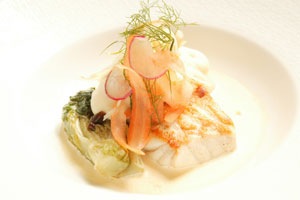
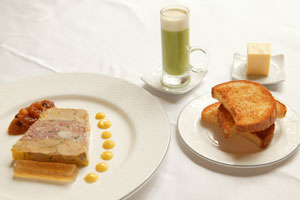
Pétrus aficionados will have spotted that the fish course, centred on turbot, was an interpretation of a classic Wareing dish. So too was the foie gras and ham hock terrine which preceded it, this being both a great-tasting dish and a perfect banqueting option because of the ease with which it can be served to large numbers.
Both dishes found their way on to the menu after Philadelphia native Arnoldi had familiarised himself with Wareing's cuisine by spending a day in the Pétrus kitchen - Arnoldi is new to the London dining scene, having transferred to the Grosvenor House from a sister Marriott property in the USA in January. The experience gave him a good insight into the type of flavour profile that Wareing likes to use and underlined a defining characteristic of the former Catey winner's food: precision. "You have to get all the elements right," says Wareing.
Arnoldi and Wareing also paid a visit to the critically acclaimed and popular Wild Honey, which - with its sister restaurant, Arbutus - has carved a niche in the quality end of the London mid-spend market, with owners Will Smith and Anthony Demetre scooping this year's Catey for Restaurateur of the Year - Independent. "The food there is bang on the money - incredibly earthy, seasonal and well executed," says Wareing. He wanted Arnoldi to be aware of the city's culinary heartbeat before working out the Cateys menu. Arnoldi notes: "Every city has its own personality, and you have to reflect that."
Picking up on the Anglo-French side of London's culinary character, Arnoldi and Wareing eventually developed the Cateys menu into an elegant, balanced dinner which kept the palate stimulated and, wherever possible, showcased quality British produce.
The menu opened with a seasonal pea and chervil velouté served in shot glasses ("a wow for the mouth", says Arnoldi), then guided guests' taste-buds through a series of classic flavour matches with modern edgings: the terrine had sweet'n'heat (pear chutney, mustard aïoli), for instance the turbot an aniseed kick, given depth by both fennel and liquorice the chocolate dessert a contemporary salted caramel ice-cream.
Arnoldi summarises the menu thus: "We wanted everything to stand on its own, but to sing together."
The menu
- Chilled pea and chervil velouté, mint cream
- Foie gras and ham hock terrine, cinnamon pear chutney, toasted brioche, English mustard aïoli
- Wild turbot with baked potato purée, oyster essence, shaved fennel and English radish, liquorice-braised baby gem (see page 56)
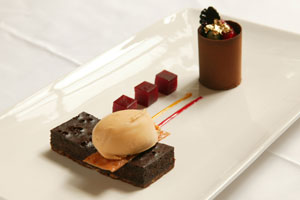
- Chocolate mascarpone cheesecake with crispy tuile and salted caramel ice-cream, mixed berries in chocolate pipe, raspberry jelly
- Coffee and petits fours (fresh mint, triple nougat layer, spiced ginger biscuit, nougat Montélimar, Turkish delight)
Richard Arnoldi, executive chef, Grosvenor House
Consultant chef: Marcus Wareing
Wine
- Taittinger Brut Réserve NV
- Louis Jadot, Bourgogne Chardonnay, France 2006
- Robert Mondavi Woodbridge Rosé (California)
- Torres Moscatel Oro (Cataluña, Spain)
Warm Valrhona chocolate and mascarpone cheesecake
(Serves 10)
For the digestive biscuit
100g digestive biscuit
30g melted butter
30g melted chocolate, Callebaut
For the mascarpone
70g egg yolks
70g sugar
185g mascarpone cheese
120g double cream
38g Valrhona chocolate, 66% cocoa solids
50g cocoa powder
38g ground almonds
50g egg white
For the accompaniment
Chocolate cylinder
Kirsch
100g raspberry sauce
60g blackberries
50g strawberries
90g blueberries
40g raspberries
Gold leaf
For the raspberry kirsch jelly
95g raspberry purée
36g sugar
Gelatine
10g kirsch
Method
Mix crumbs, butter and chocolate, spread out on a rectangular tray (or trays). Cream yolks and sugar and fold in mascarpone cheese and cream. Fold in finely chopped chocolate, cocoa powder and ground almonds. Whisk egg white until stiff and fold into the mascarpone base. Pour over the digestive biscuit and cook in a water bath at 160°C for 40 minutes. Cool down and cut into rectangles 4cm x 9cm. Serve warm.
Accompany with a chocolate cylinder containing kirsch-flavoured red fruit bound with a fruit jelly and decorated with gold leaf. Garnish the cheesecake with brandy snaps and pâté de fruit - raspberry sauce, mango sauce and salted caramel ice. For the jelly, boil the raspberry purée and sugar. Add the gelatine and alcohol.
Foie Gras and Ham Hock Terrine with Pear and Raisin Chutney and English Mustard Aioli
(Serves about 12)
For the foie gras terrine
500g foie gras
1kg ham hock
50g carrots
50g onions
60g celery
5cm of cinnamon stick
1 bay leaf
20g garlic
Salt and pepper
3 presoaked gelatine leaves
20g chopped fresh parsley
For the pear and raisin chutney
(Makes about 15kg)
60ml olive oil
1tsp fresh rosemary, finely chopped
200g sultanas
100g raisins
100g demerara sugar or coconut sugar
400ml cider vinegar
100g crystallised ginger, finely sliced
800g pears cored and cut into wedges
1/2tsp sea salt
1/2tsp nutmeg, freshly grated
2tsp ground allspice
1 good pinch of saffron
For the English mustard aïoli
(Makes 1.1kg)
1 litre olive oil
10 cloves of garlic
1tsp dry English mustard
3 egg yolks
Salt and pepper
Method
For the terrine, braise the ham hock with the carrots, onions, celery, garlic, cinnamon stick and bay leaf. Cook for about two hours until the ham is falling from the bone. Pull the ham into rough pieces. Cool to room temperature. Strain 300ml of the stock into a separate saucepan, bring to the boil and whisk in the three presoaked gelatine leaves. Reserve at room temperature. Don't set. Line a terrine with plastic film, trim the edges to fit the whole terrine. Remove top layer of film and place in terrine.
Pan-fry the foie gras for no more than three seconds on each side. Mix a third of the parsley with the foie gras pieces. Pack half of the foie gras into the bottom of the terrine mould. Fold another third of the parsley into the ham, then loosely pack on the layer of foie gras.
Lay the other half of the foie gras on top of the ham until you have filled the terrine. Add the last third of the parsley to the half-pint of stock and then pour in the stock and gelatine. Leave to set for 24 hours. Turn out and carve when set. Serve on a plate with dressed leaf, chutney and herb oil.
For the chutney, heat the oil in a large pan and add the rosemary, sultanas, raisins and sugar. Fry them until the fruit begins to caramelise. Pour in the vinegar and boil on a high heat for three minutes. Add the rest of the ingredients, bring to the boil, then turn to a simmer and cook until most of the liquid has evaporated. Stir it well and don't let the pears cook too much they should keep their shape.
Spoon it into clean hot jars, filling them as full as you can, and seal while hot. Store in the fridge.
For the aïoli, remove the cloves from a head of garlic and peel them carefully. Halve each clove lengthwise and remove the central germ, if old, which is indigestible. Coarsely crush the cloves in a mortar with the mustard. Finely crush the mustard using a pestle. During this process, begin adding salt (fleur de sel, preferably). This takes time and should continue until the garlic is reduce


